
By Malik Rashid, Last updated: October 25, 2026
Many businesses don’t have a content problem. They have a ‘what is this page even for’ problem. A blog post goes up every week, nobody reads it, and six months later the owner wonders where the leads went. Content marketing services exist to fix that, by tying every article, page and email to a search, a buyer question and a result you can measure.
This guide covers what content marketing services include, what they cost, how long they take and how to pick a provider without getting burned. It comes from the team at BoostBranding, a digital marketing agency in Bahawalpur, Pakistan that works on SEO, content and web projects, so we’ll be straight about where an agency helps and where you may not need one.
Quick answer: Content marketing services are a managed program where specialists plan, write, optimize, publish, promote and measure content that attracts and converts a defined audience. Expect strategy, keyword research, content creation, SEO, distribution and reporting. Published prices range from under £1,000 a month for small UK retainers to $5,000 to $15,000 a month for B2B programs, and most programs need several months before results are clear.
What Are Content Marketing Services?
Content marketing services are professional support for planning, creating, publishing, promoting and measuring content that pulls a defined audience toward a business goal. You hand the process to specialists instead of building every skill in-house.
The Content Marketing Institute describes content marketing as a strategic approach built on valuable, relevant and consistent content that attracts and keeps a clearly defined audience and leads to profitable customer action. Read that closely and you’ll notice what’s missing: it doesn’t say ‘publish often’. It says the content has a defined audience and a business outcome. Good services start there.
Content Marketing vs SEO, Copywriting and Content Writing
People use these terms interchangeably, and providers sometimes sell one while calling it another. Here’s how they differ.
| Main job | Typical output | Success looks like | |
|---|---|---|---|
| Content marketing | Attract and convert an audience over time | Strategy, articles, guides, emails, case studies | Qualified leads, authority |
| SEO | Make pages easy to find in search | Technical fixes, keyword targeting, links | Rankings, organic traffic |
| Copywriting | Persuade someone to act now | Landing pages, ads, product copy | Conversions |
| Content writing | Produce informational text | Blog posts, guides | Finished, accurate pieces |
Content writing is a part of content marketing, not the whole thing. If a provider only sends you drafts, you’re buying writing, not a program. SEO is the other big overlap. If you’re new to it, our explainer on what is SEO shows how rankings, technical fixes and content fit together.
What Do Content Marketing Services Include?
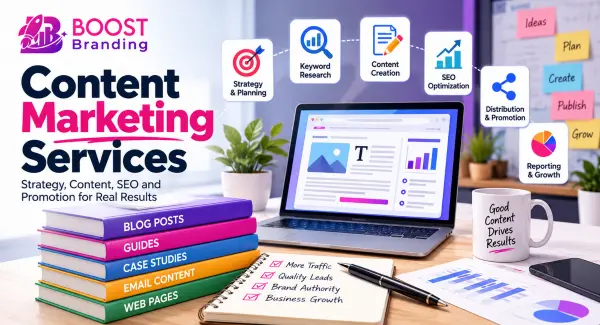
Most content marketing services cover six jobs: strategy, research, creation, optimization, distribution, and reporting with refreshes. Some providers do all six, others only a few, so check which ones your quote actually includes.
Content Strategy and Planning
Strategy decides what gets made and why. It starts with your goals, your buyers and the questions they ask before they buy. From there, a good plan maps topics to funnel stages, picks the page type for each topic (service page, guide, comparison, case study) and sets a realistic publishing calendar. The calendar matters less than the logic behind it. A plan that can’t explain why a topic is on the list is a guess.
Keyword and Topic Research
Research turns search demand into priorities. A provider should group keywords by intent, separating people who are curious from people who are ready to hire. Your own Google Search Console data helps here, because it shows the exact words real visitors used. Research should also flag overlap, since two of your pages chasing the same keyword compete with each other, which is called cannibalization. Newer research also looks at the conversational questions people ask AI tools, not just short keywords.
Content Creation
Creation covers the writing, editing and design of the actual assets. Common formats include blog posts, service pages, in-depth guides, case studies, whitepapers, email newsletters, social posts, video scripts, infographics, press releases and guest articles. The best work uses real input from your team. Sales calls reveal objections, and product staff know the details competitors skip. A writer who never talks to anyone in your business is guessing at your expertise.
Optimization for Google and AI Answers
Optimization shapes each page so search engines and readers can understand it. That means a clear heading structure, a direct answer near the top of each section, descriptive internal links, structured data where it fits and sources for key claims. It overlaps with technical SEO, which is why many teams pair writing with SEO services, so site speed, indexing and structure problems get fixed alongside the content.
Distribution and Promotion
Publishing isn’t the finish line. Distribution gets the asset in front of people through email, social channels, sales follow-ups, partner mentions and sometimes paid boosts. One strong guide can become a newsletter segment, a few LinkedIn posts and a talking point for your sales team. Promotion fits naturally with broader digital marketing services, since the same audience often sees your search, social and email touchpoints in the same week.
Reporting and Refresh
Reporting shows what worked, and refreshing keeps older pages from decaying. Useful reports connect pages to business results, such as leads, calls and sales conversations, instead of stopping at traffic. Refreshing means updating stale facts, merging overlapping pages and improving internal links. A yearly review of important pages is a sensible default, though fast-moving topics may need it sooner.
How a Content Marketing Engagement Works
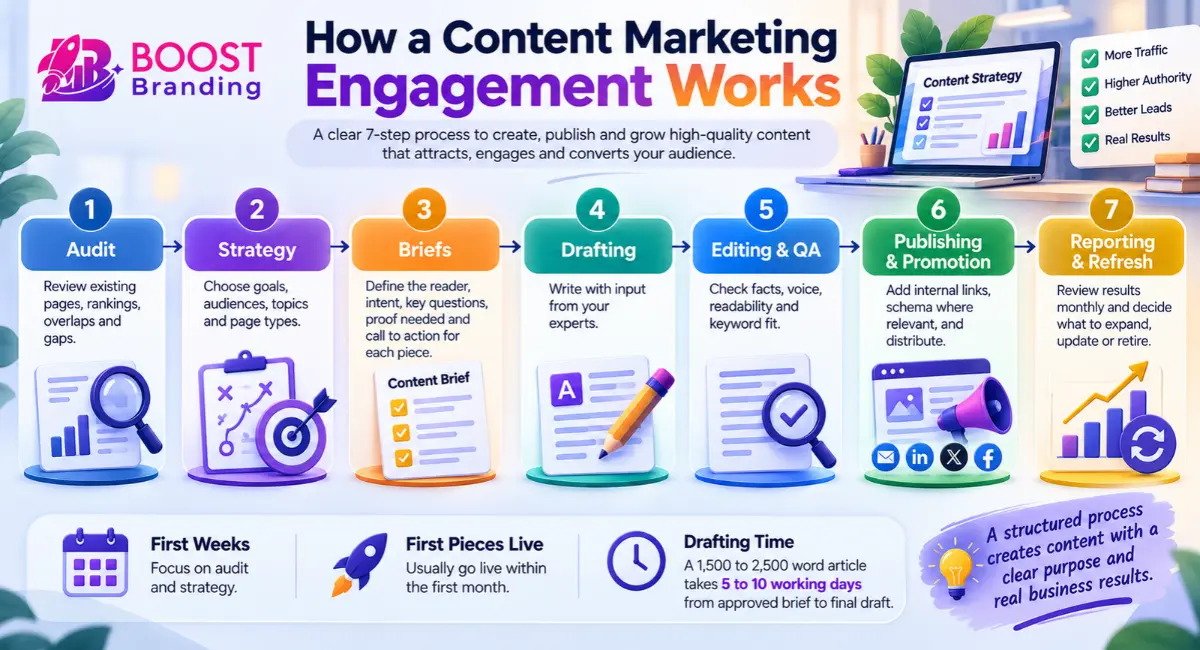
A typical engagement runs through seven steps, and the order matters because skipping early steps is how content ends up with no purpose.
- Audit. Review existing pages, rankings, overlaps and gaps.
- Strategy. Choose goals, audiences, topics and page types.
- Briefs. Define the reader, intent, key questions, proof needed and call to action for each piece.
- Drafting. Write with input from your experts.
- Editing and QA. Check facts, voice, readability and keyword fit.
- Publishing and promotion. Add internal links, schema where relevant, and distribute.
- Reporting and refresh. Review results monthly and decide what to expand, update or retire.
In practice, the first weeks go to the audit and strategy, and the first pieces usually go live within the first month. Drafting time depends on research depth and how quickly you review. One UK agency guide puts a 1,500 to 2,500 word article at five to ten working days from approved brief to final draft.
How Much Do Content Marketing Services Cost?
Content marketing services cost anywhere from a few hundred dollars for one-off writing to several thousand a month for full programs. The range is wide because you’re paying for different things: some providers sell words, others sell strategy, SEO and reporting.
Published pricing guides give a rough picture. These are US and UK figures from the open market, not BoostBranding prices.
| Option | Published range | Notes |
|---|---|---|
| Freelancer, per blog post | $150 to $600 | Usually writing only |
| Freelancer, monthly | $1,000 to $10,000, or $60 to $200+ per hour | You manage the work |
| UK small-business agency retainer | £800 to £3,500 per month | Often includes SEO input |
| US agency content programs | $2,500 to $10,000 per month | Scope varies by business goals |
| Mid-market B2B full-service | $5,000 to $15,000 per month | Strategy, pillars, case studies |
| BoostBranding | [Insert your package tiers in USD and PKR, and what each includes] |
Sources: published agency pricing guides from the US and UK, reviewed October 2026. Ranges are indicative and change by scope.
Several things move the price: how many pieces you want, how deep the research goes, how much expert input a topic needs, which formats you choose (video costs more than text), how fast you need it and how detailed the reporting is.
Don’t judge a quote by the price per article alone. A cheap article that doesn’t match search intent or connect to a page that converts costs you more in the end than a pricier one that does. A better yardstick is cost per qualified lead over a period of months. If you’re on a tight budget, start with fewer, better pieces and refresh what you already have before commissioning dozens of new posts.
Agency, Freelancer or In-House?
The right model depends on how much you publish, how much strategy you need and how much management time you can spare. There’s no universal winner, and many businesses end up with a hybrid.
| In-house | Freelancer | Agency | |
|---|---|---|---|
| Strategy included | Only if you hire for it | Rarely | Usually |
| SEO integration | Depends on the hire | Often separate | Often built in |
| Consistency | High | Varies | High |
| Scaling up | Slow (hiring) | Limited | Faster |
| Main risk | Cost and bandwidth | Continuity if they leave | Weak fit or thin account attention |
| Best for | Steady, high-volume publishing with an SEO lead | Defined projects with a clear brief | Teams wanting strategy, writing and reporting together |
A freelancer is a good fit for a one-off job, such as a website copy refresh or a few case studies, provided you can write a clear brief. An in-house writer makes sense once you publish constantly and have someone senior to direct the work. An agency fits teams that want strategy, writing, SEO and reporting under one roof. A hybrid, where a lean in-house marketer manages an outside partner, is common and often works well.
How Long Does Content Marketing Take to Work?
You’ll usually see early signals within weeks and meaningful traffic and lead growth over several months. Early signals are things like new pages getting indexed, impressions rising in Search Console and readers spending time on the page. Leads come later.
Timing depends on your site’s authority, how competitive the topic is, the page type, technical health, how often you publish and whether you’re creating new pages or improving existing ones. Updates to pages that already have some history can move faster than brand-new content. Anyone who promises a specific ranking by a specific date is guessing. Search engines don’t offer guarantees, and a provider who says otherwise is a red flag.
How to Measure Content Marketing Results
Measure each page against the job you gave it, not against a single traffic number. A service page and a blog guide shouldn’t be judged by the same metric.
| Page type | Its job | What to track |
|---|---|---|
| Service page | Turn visitors into inquiries | Form fills, calls, quote requests |
| Blog guide | Attract and educate | Organic clicks, engaged sessions, assisted conversions |
| Case study | Build proof | Views by people who later inquire |
| Email newsletter | Keep prospects warm | Clicks, replies, returning visitors |
| Refreshed page | Recover or improve | Ranking and traffic change after the update |
Google Search Console shows queries, clicks and rankings, and GA4 shows behavior and conversions. Your own inquiry log or CRM is the most important source, because it shows which content brought real customers. Report monthly, and make every chart point to a decision: expand a winner, fix a decline or retire a weak page.
Content Marketing in the AI Search Era
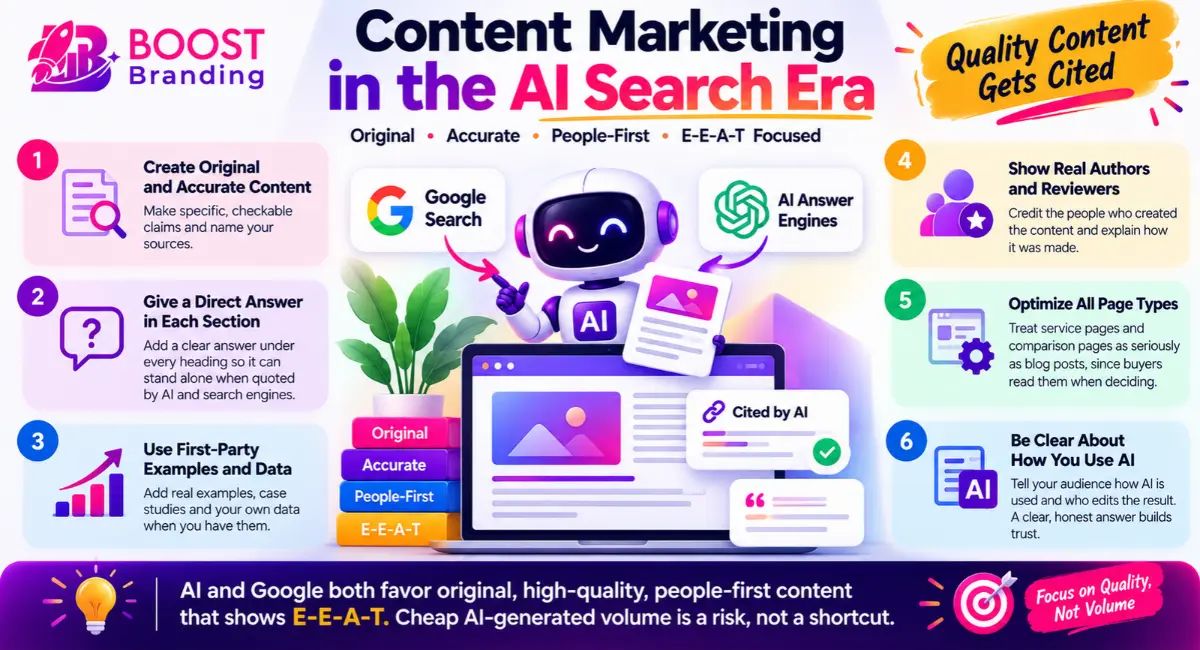
AI answer engines and Google both favor original, accurate, people-first content with clear authorship, so cheap AI-generated volume is a risk, not a shortcut. Content that says what every competitor says gives them no reason to cite you.
Google’s own stance is that, however content is produced, the goal should be original, high-quality, people-first content that shows E-E-A-T. Its guidance also encourages being clear about who created a piece and how it was made. You can read it in Google’s guidance on AI-generated content.
In practice, that points to a few habits:
- Make specific, checkable claims, and name your sources.
- Put a direct answer under each heading so a section can stand alone when quoted.
- Add first-party examples and data when you have them.
- Credit real authors and reviewers.
- Treat service pages and comparison pages as seriously as blog posts, since buyers read them when deciding.
Ask any provider how they use AI and who edits the result. A clear, honest answer is a good sign.
Who Needs Content Marketing Services?
Content marketing services fit businesses that sell something people research before buying. The shape of the work changes by audience.
Startups and Small Businesses
They usually need focus: a few strong pages, a handful of useful guides and a simple distribution habit.
B2B and Professional Services Firms
They need depth. Buyers often include several people, so content has to give technical readers detail, finance readers cost and risk context, and leaders a reason to act.
Ecommerce Brands
They need category pages, buying guides and product content that help shoppers choose.
Local and Service Businesses
They benefit from pages that answer the practical questions customers ask before calling.
Businesses Selling Across Borders
Pakistan-based companies serving buyers in the US, UK or Gulf should write for the buyer’s market, not their own. Spelling, regulations, price references and examples all signal whether you understand the reader.
When You May Not Need an Agency Yet
You probably don’t need an agency yet if you can’t describe your offer in a sentence, have no budget for at least six months of effort, or have nobody who can review drafts. In those cases, start in-house and bring in help once the basics are clear.
How to Choose a Content Marketing Provider
Choose the provider who can show you their thinking before they write a word. Anyone can send a portfolio, but the process behind it tells you far more.
Questions to Ask Before You Hire
- Who writes and edits the content, and what is their background in my sector?
- Can I see a sample brief and a sample monthly report?
- How do you pick topics, and how do you check for overlap with my existing pages?
- How do you use AI, and what human review happens before publishing?
- How do you source and verify facts and statistics?
- Who owns the content and the accounts, and what happens if I leave?
- How do you tie results to leads and sales, not just traffic?
Red Flags to Watch For
- Guaranteed rankings or guaranteed traffic by a date
- Reports that show only impressions or follower counts
- Content delivered without a brief or any keyword logic
- No named writers, or no human editing
- Vague or missing contract exit terms
- A price per article with no strategy attached
Common Content Marketing Mistakes
The most common mistake is publishing without giving each page a job. If you can’t say what a piece should achieve, who it’s for and what the reader should do next, it’s a candidate for the bin before it’s written.
Chasing volume is a close second. Two well-researched articles a month usually beat ten generic ones. Another frequent mistake is ignoring existing content. Old pages often hold your best chance of quick gains, and they’re often neglected while new pages pile up.
Many teams also forget distribution, so good pages sit unseen. Others measure only traffic and then wonder why sales stay flat. And plenty skip expert input, which is how you get articles that read fine but say nothing a buyer can use.
Worked Example: A Content Brief and a 30-Day Plan
Here’s what a useful brief looks like in practice. This is a hypothetical example (a software house selling app development to US startups), not a client.
Example Content Brief
- Page job: Rank for ‘mobile app development company for startups’ and book scoping calls
- Reader: A non-technical founder with seed funding comparing three vendors
- Search intent: Commercial investigation
- Must answer: Cost range, timeline, how the process works, how to vet a team, red flags
- Proof needed: One real project with an outcome and client permission
- Internal links: Service page, one case study, pricing page
- Call to action: Book a 20-minute scoping call
- Distribution: LinkedIn post, sales follow-up email, founder-community answer
- Success metric: Five qualified calls in 90 days (a target, not a promise)
The output is a page outline with a direct answer first, a cost table with honest ranges, a vetting checklist, the proof block and a clear call to action. The brief tells the writer what to include and the reviewer what to check.
Your First 30 Days
| Week | Focus |
|---|---|
| 1 | Audit existing pages with Search Console, find overlaps, pick three priority pages |
| 2 | Finalize strategy and write briefs |
| 3 | Draft the first two pieces and run expert review |
| 4 | Publish, add internal links, distribute and record baseline numbers |
The Five-Question Page-Job Test
Before approving any piece, ask: Who is this for? What do they want to know? What should they do next? How will we know it worked? And is there already a page on our site doing this job?
Why Work With BoostBranding
BoostBranding is a digital marketing agency based in Bahawalpur, Pakistan. The team handles SEO, content marketing, digital marketing, lead generation, graphic design, video editing, web development and hosting, so content work can connect to the pages and technical setup around it. The site lists Malik Kashif as founder and CEO, Malik Rashid on SEO and blogging, and Husnain Ali as WordPress and SEO specialist.
If you want a starting point, we can review your current content, point out overlaps and gaps, and suggest where to focus first. Request a content audit
Frequently Asked Questions
What are content marketing services?
Content marketing services are professional help with planning, creating, optimizing, publishing, promoting and measuring content that attracts a defined audience and supports a business goal. A provider typically handles strategy, keyword research, writing, SEO, distribution and reporting so your team doesn’t have to build that skill set in-house.
What do content marketing services include?
Most content marketing services include strategy, keyword and topic research, content creation, on-page SEO, distribution and reporting. Many also cover content audits and refreshes of older pages, plus formats such as case studies, email newsletters and video scripts.
What does a content marketing agency do?
A content marketing agency decides what content should exist, who it should serve and how it will be found, then plans, writes, optimizes, promotes and measures it for you. The work is usually delivered on a monthly retainer or as a defined project.
What types of content do content marketing services produce?
Content marketing services can produce blog posts, service pages, guides, case studies, whitepapers, email newsletters, social posts, video scripts, infographics and press releases. The right mix depends on your audience and where they are in the buying process.
How much do content marketing services cost?
Content marketing services cost anywhere from under £1,000 a month for small UK retainers to $5,000 to $15,000 a month for B2B programs. Published pricing guides show freelancers, small UK retainers and US agencies sitting in very different ranges, so compare what each package delivers, not just the price.
How long does content marketing take to work?
Content marketing usually shows early signals within weeks and meaningful traffic and lead growth over several months. Timing depends on your site’s authority, the competition, how often you publish and whether you’re creating new pages or improving existing ones.
What is the difference between content marketing and SEO?
Content marketing is the broader program of creating useful content for an audience, while SEO is the work of making pages easy to find in search. They overlap heavily, because content that isn’t optimized rarely gets found and optimized pages without useful content rarely convert.
Should I hire an agency, a freelancer or an in-house writer?
The right choice depends on volume, budget and how much strategy you need. A freelancer suits defined projects, an in-house hire suits steady high-volume publishing with an SEO lead, and an agency suits teams that want strategy, writing, SEO and reporting from one place.
Can AI-generated content rank on Google?
Google says it cares about whether content is original, high quality and helpful to people, not about how it was produced. In practice, unedited AI text that repeats what every competitor says tends to be weak, so human expertise, fact-checking and clear authorship still matter.
Can you refresh our existing content instead of writing new pages?
Yes, refreshing existing pages is often the quickest win because those pages already have history. A refresh can mean updating outdated facts, merging overlapping pages, improving internal links and rewriting sections that no longer match search intent.
How do you measure content marketing ROI?
You measure content marketing ROI by connecting each page to a business result, such as leads, calls, sales conversations or revenue, rather than only counting traffic. Tools like Google Search Console and GA4 show rankings, clicks and conversions, and your CRM or inquiry log shows which content brought real customers.
What should I ask before hiring a content marketing agency?
Ask who writes and edits the content, how they research topics, how they use AI, how they report results and what happens if you leave. Also ask to see a sample brief and a sample report, because those show whether you’re buying strategy or just words.
Do content marketing services work for B2B and ecommerce businesses?
Yes, but the content looks different for each. B2B content usually needs proof and detail for several decision-makers, while ecommerce content focuses on category pages, buying guides and product information that help shoppers choose.
Do I need content marketing services if I already have a blog?
Not necessarily, but a blog without a strategy often stalls. If your posts get little traffic or no leads, a content audit can show whether you need new topics, better optimization, stronger internal links or a refresh of what you already have.
Ready to Plan Your Content?
Tell us what you sell, who buys it and which pages you already have. We’ll show you where content can do more work. Request a content audit